

Queue Management System for Hospitals
- Home
- Queue/OPD Management System
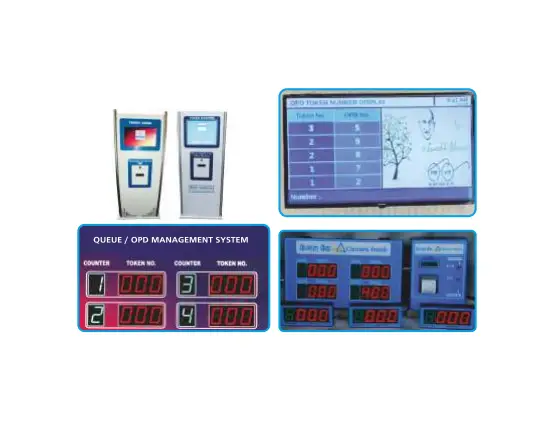
OPD/QUEUE Management System
GADDIEL QUEUE / OPD MANAGEMENT SYSTEM
Hospital OPD QUEUE Management Software is very useful to manage OPD Department of Hospital. By this system process of Outdoor patient Department in Hospitals can easily be managed.
This system is also very useful for pharmacy, Restaurant & Banks.
Gaddiel Industries Pvt. Ltd
Reasons of Choosing Us
Comprehensive Products
We offers a wide selection of high-quality products, from interior products to advanced surgical instruments and patient care devices.
Quality Assurance
The company ensures that all products meet stringent medical standards and certifications, providing reliable and safe equipment.
Exceptional Customer Support
We prioritizes customer satisfaction by offering professional guidance, after-sales service, and timely delivery
Safe and Reliable
Ensures uninterrupted supply of gases like oxygen, nitrous oxide, and medical air. Meets standards like NFPA 99, HTM 02-01.
Ease of Maintenance
Modular components allow for quick installation, easy maintenance minimize downtime and ensure long-term functionality.
Queue Management System Guide for Better Patient Care
Queue management system in the 21st Century The Importance of Managing Patient Flow in HealthcareIn quick-moving healthcare environments, having effective patient flow management processes is essential for timely treatment. When the waiting times are long, and patients need to wait outside in crowded spaces with disorganised queue systems it can easily affect patient satisfaction and hospital management. This is the point where a Queue Management System (QMS) for hospitals steps in.
Queue Management System for Hospitals: What Is It?
A OPD/queue management system is a digital solution that helps to manage patient flow inside the hospital. It assists in queue organization, appointment management, and decreased waiting times by effectively directing patients to the required department or service. Modern QMS solutions add a different experience altogether through automation, real-time tracking and notifications unlike manual systems.
Several Critical features of Hospital Queuing Management System
Here are the few important aspects that a professional OPD management system must have:
Token Generation: Upon arrival, patients are given digital or printed tokens.
Real-Time Queue Tracker: Shows current queue status on screens or mobile devicesScheduling Appointments – Allows patients to schedule future visits.
SMS & Notification Alerts: Information on turn take.
Integrated One Single Window: Enables multi-departmental integration of OPD, labs & billing queues.
Benefits of Queue Management Systems
Here are several key benefits of implementing a quality management system (QMS) within the hospital and other healthcare-related organizations for getting closer to not just success but excellence:
Minimized Waiting Time: Proper scheduling prevents waiting.
Enhanced Patient Satisfaction: Transparency and organization are key ingredients in the patient experience.
Improved Staff Productivity: Instead of dealing with the crowds, staff can focus on patient care.
Data Insights: Hospitals can examine patient movement and improve processes with insights.
How Queue Management Systems Work
This system usually goes through a straightforward workflow. Patients arrive and register at a kiosk or reception, receiving a token. The system then places these individuals in a virtual queue and directs them to the appropriate department. They are alerted through display screens or mobile alerts as their turn nears. This minimizes the disruptions from the entry process to getting started with your consultation.
Types of Queue Management Systems
Depending on the hospital needs, queue systems can vary:
Linear Queue: First-come, first-served approach.
Virtual Queue: Patients are alerted when it’s their turn, after waiting remotely.
Appointment-Based Queue: Arranging appointments cuts down waiting time and overcrowding.
Implementation Process
There are important steps to consider while adopting a queue management system:
- Assessing hospital requirements
- Selecting the right software solution
- Training staff
- Deploying and monitoring the system
When someone properly implements a solution, it should work like magic.
Challenges and Solutions
Every hospital comes across some barriers to implement innovation like change resistance, technical issues, budget restrictions, etc. These drawbacks can, nevertheless, be overcome by appropriate training of personnel and/or the selection of systems that are user-friendly and skilled phased implementation strategies.
Future Trends
Question: Why? Future Queue Management in the Hospitals AI (driven by advanced technologies), Mobile based queueing and Contactless These innovations will improve efficiency and patient convenience even further.
Conclusion
Hospital Queue Management — Not an Option, but a Must-Have Healthcare is one such industry where it has the ability to provide better services by improving operational efficiency, reducing wait times, and increasing patient satisfaction. In such a scenario, it would be only how smart queue management solutions will help hospitals to cope up with the digital-age patient requirements.
Frequently Asked Questions
A compilation of frequently asked questions providing concise information on installation, maintenance, safety protocols, troubleshooting, and service details.
What are the key features of a Modular OT?
It includes HEPA filters, laminar airflow, antimicrobial wall panels, seamless flooring, and integrated medical equipment for a sterile environment.
What are the benefits of a Modular OT in hospitals?
It provides a sterile and controlled environment, reduces infection risks, ensures efficient space utilization, and improves overall surgical outcomes.
How does a Modular OT improve infection control?
With HEPA filtration, laminar airflow, and antibacterial surfaces, it minimizes airborne contaminants, ensuring a sterile surgical environment.
Can a Modular OT be customized as per hospital requirements?
Yes, it can be tailored to specific medical needs, incorporating specialized equipment, lighting, and workflow efficiency.
How long does it take to install a Modular OT?
Installation is faster than traditional OTs and can be completed within a few weeks, depending on the complexity.
1. What is a Queue Management System (QMS) in hospitals?
2. How does a hospital Queue Management System work?
3. What are the benefits of using a Queue Management System in hospitals?
4. Can a Queue Management System integrate with hospital management software?
5. Is a Queue Management System suitable for all types of hospitals?
Yes, it can be implemented in multi-specialty hospitals, clinics, diagnostic centers, and government hospitals to manage patient flow efficiently.