


23
MarLets discuss about minor operation theatre vs major operation theatre in hospitals with major differences.
While visiting a hospital, you will often listen to some terms such as minor OT (Operation Theatre) and major OT. These two facilities are essential to surgical treatments, but they have different applications based on how complicated the procedure is. This post was contributed by a community member. Find out more about the community here understand the difference between minor and major operation theatre. Patients and healthcare professionals can rarely comprehend the way hospitals manage surgical care, especially when it comes to the differences in conducting minor and major surgeries.
This blog will cover in detail what a minor OT in a hospital is, defining what an operation is considered a major, and the differences between the two operation theatres in terms of equipment, procedures, and patient care.
Minor OT in Hospital — what it is?
A mini OT in a hospital is a small operation theatre that is used to perform simple and low-risk surgical procedures. Many of these procedures can be completed either under local anesthesia and will be performed in an outpatient setting as elements to the same day or may not banyan away time.
A minor operation theatre is generally used for procedures requiring minimal surgical intervention and fast recovery. In many cases, you’ll be able to go home the same day.
Commonly Performed Procedures in Minor Operation Theatre
Some of the surgical procedure which can be done safely in a minor OT are:
- Stitching and suturing wounds
- Small cyst / lipoma excisions
- Dressing of deep wounds
- Minor orthopedic procedures
- Incision and drainage of abscesses
- Removal of ingrown toenails
- Skin biopsy procedures
As these procedures are relatively uncomplicated, only local anesthesia is necessary as opposed to general anesthesia.
Read Related – Hospital Interior Design: Ideas & Images for Small Hospitals
The Equipment Located In A Small Operation Theatre
A minor operation theatre is less extensive than a major OT, it includes primary medical devices such as,
- Basic surgical instruments
- Examination lights
- Sterilization equipment
- Minor surgical tables
- Monitoring devices for vital signs
A minor OT in hospital is aimed at performing minor surgeries in a sterile environment, in a quick manner.
What is a Major Operation?
A major operation is defined as the entire surgical procedure that will penetrate to deeper tissues or involving organs or organ systems. Such surgeries typically involve the use of high-end medical equipment, specialist surgeons and a fully functioning major operation theatre.
That requires longer periods of general anesthesia, which is the regular setting for major surgeries. Major operations also require close observation before and immediately after the procedure.
Examples of Major Operations
- Big operations are done for severe health problems and may include:
- Heart surgery
- Brain surgery
- Organ transplants
- Joint replacement surgery
- Cancer tumor removal
Surgical procedures in the abdomen for instance gallbladder or bowel operation
Spine surgery
These procedures are more complex and need specialist surgical teams.
What to Look for in a Major OT
A main operating theater designed to accommodate certain types of surgical conditions and allows for a greater clinical level regarding the sterile field and base standards for care practices. It typically is much bigger and more high-tech than a small, minor OT.
Key features include:
- Advanced surgical equipment
- Anesthesia machines
- Ventilators
- Surgical microscopes
- Imaging devices
- Advanced patient monitoring systems
Surgical Infection control related to major operation theatres The special air flow is directed from right to left.
Difference Between Minor Operation Theatre and Major Operation
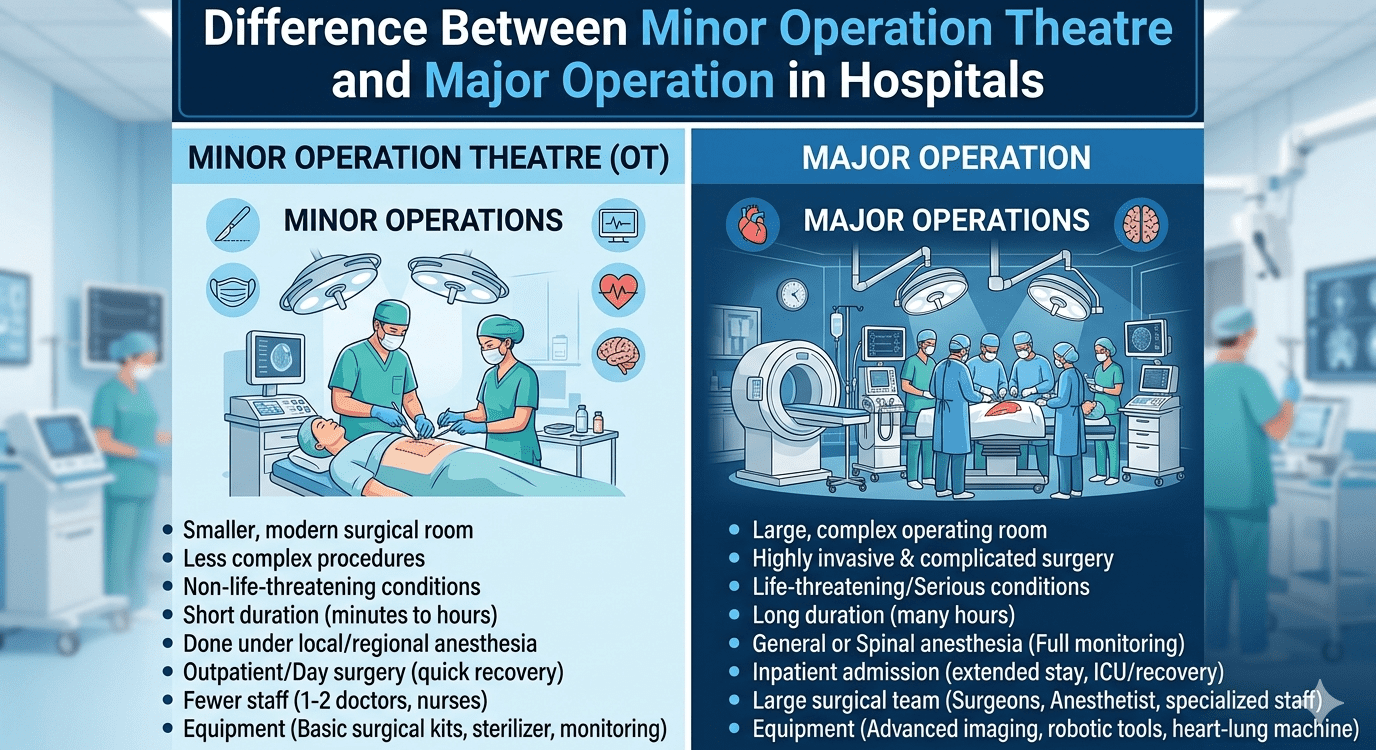
Minor OT in hospital and major operation theatre difference is something that both patients and healthcare providers need to understand.
Complexity of Procedures
The main distinction is the complexity of the processes. Simple procedures are done in the minor operation theatre and complex surgeries involving an organ or bigger body systems require a major operation theatre.
Type of Anesthesia
Local anesthesia is usually required for minor procedures so that patients can stay awake during the surgery. However, major operations often call for general anesthesia that will put the patient entirely to sleep for the whole surgery.
Duration of Surgery
Minor OT procedures tend to be of shorter duration and can be over in minutes to an hour. Longer surgeries can take a few hours, though, for instance an apparent hernia operation.
Recovery Time
Minor procedures are typically done on an outpatient basis, so patients recover quickly and may be discharged the same day. In contrast, patients who have larger surgeries require longer hospital stay and interventions following surgery.
Medical Equipment
A minor operation theatre consists of very basic surgical equipment, whereas a major operation theatre is basic with advanced technology required for more complex surgeries and procedures.
Significance of Two Operation Theatres in the Hospitals
Minor and major operation theatres are an integral part of the modern healthcare facilities. They help hospitals streamline surgical processes with varied types of procedures without compromising on patient safety.
About a minor OT in a hospital Minor OT stuff Briefly, a minor OT allows doctors to conduct rapid procedures without using major surgical facilities. As a result, this increases the efficiency of hospitals while giving less time for patients to wait.
Major operation theatres, on the other hand, utilize high-level technology, along with highly-skilled operating teams, so as complex and life-saving surgeries can be performed.
These operation theatres allow hospitals to provide different kinds of surgery for the patients with different medical needs.
Conclusion
Comparison between a minor and major modular operation theater – The difference between a minor operation theatre and a major operation theatre primarily lies within the procedure complexities, the equipment needed, and patient care requirements. Minor OT for short and uncomplicated surgery in the hospital whereas major operations need sophisticated technology, a specialized surgeon, and prolonged monitoring of the patient.