


31
JulIn modern hospitals, it is very important to have a sterile environment for the patient and successful surgical outcomes. HEPA filter is one of the major components used in clean rooms, operation theatres (OTs), and other laminar airflow systems. Healthcare professionals and hospital administrators typically search for what is HEPA filter full form, HEPA full form, role of HEPA filter for OT etc in order to gain perspective on how these systems are mitigating airborne infections.
In this article, we will explain the full meaning of HEPA, how HEPA filters work, and why HEPA filters in laminar air flow systems are essential for infection control in hospitals. We will also explore their critical role in maintaining clean, sterile air inside a modular Operation theater, helping reduce airborne contaminants and ensuring a safer surgical environment for patients and healthcare professionals.
HEPA Filter Full Form
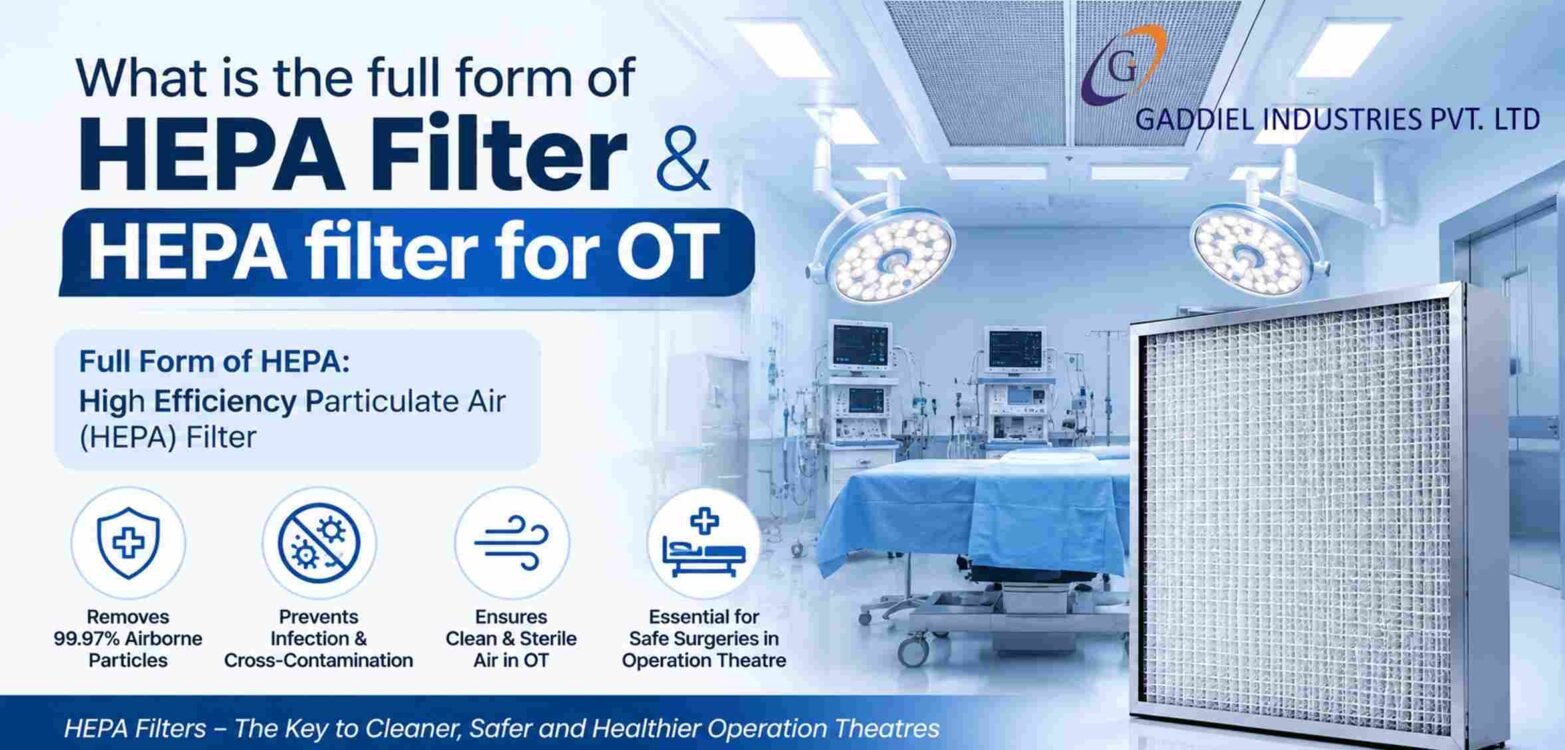
HEPA filter full form is High-Efficiency Particulate Air filter.
HEPA stands for a filter that can vacuum out tiny airborne particles at very high air pollution filtration efficiency. A real High-Efficiency Particulate Air filter captures 99.97% of particles as small as 0.3 microns in size, the most penetrating particle diameter size (MPPS).
HEPA Full Form
HEPA full form is also High-Efficiency Particulate Air. The words HEPA filter full form and HEPA full form are used interchangeably where hospital infrastructure and HVAC discussions are concerned.
What is a HEPA Filter?
HEPA filter– A high-efficiency particulate air filter consisting of a mat of randomly arranged fibers (commonly composed of fiberglass or synthetic materials). Air is filtered through the filter, these particles have been caught in the fiber structure of cellulose: dust, ash, bacteria, fungal spores and other pollution.
Some of the common uses for High-Efficiency Particulate Air filter are:
- Operation theatres (OTs)
- Intensive Care Units (ICUs)
- Pharmaceutical clean rooms
- Laboratory environments
- Laminar airflow systems
Read Related – Medical Equipment List: Names and Their Uses
How Does a HEPA Filter Work?
High-Efficiency Particulate Air filter work by trapping particles in three different ways:
- Interception
As the airflow containing particles passes through a filter, they come into contact with and adhere to the unaffectable fiber surfaces of the filter [1].
- Impaction
Because larger particles cannot rotate with the flow of air that changes its direction around the fibers, they collide directly with them.
- Diffusion
Brownian motion causes the very small particles to move randomly, increasing the probability of capture by filter fibers.
These synergistic mechanisms help High-Efficiency Particulate Air filter to trap particles of both larger and microscopic sizes.
Laminar Air Flow ( LAF ) – HEPA Filter
One of the major applications in hospitals are laminar air flow systems with High-Efficiency Particulate Air filter.
What is Laminar Air Flow?
Laminar Air Flow (LAF) is a ventilation system that provides clean air in the same direction and at constant velocity. Airflow is designed to minimize turbulence and prevent any airborne contamination from affecting the critical areas of a cleanroom.
Important HEPA Filter for Laminar Air Flow
In a laminar airflow system ,air is drawn through pre-filters ,From there it blows through the HEPA filter,The cleaned air is given parallelly to the clean zone.The air full with contaminants is expelled from the critical zone through return ducts.
A laminar airflow system would not be capable of delivering the level of cleanliness needed for surgical procedures and sterile manufacturing if there was no High-Efficiency Particulate Air filter in place.
Advantages of HEPA Filter suitable for Laminar Air Flow
- Removes airborne bacteria and dust
- Maintains a sterile surgical field
- Decreases the rates of infections at the surgical site
- Improves indoor air quality
- Helps maintain clean room compliance in hospitals
Importance of HEPA Filtration in OT
On surgical occasions when there is exposure of the host body, even a small number of airborne microorganisms can present an infection threat. High-Efficiency Particulate Air filter systems can be used to create a sterile environment surrounding the operating table and surgical instruments.
Air Quality Standards in OT
- 20–25 air changes per hour (ACH) or greater
- Positive air pressure
- Temperature control (20–24°C)
- Relative humidity control (40–60%)
- HEPA-filtered air supply
Such conditions reduce airborne contamination and improve surgical outcomes.
Read Related – OT Full Form in Medical: Everything About Operation Theatre
Installing a HEPA Filter for OT
HEPA filters are usually placed in the ceiling-mounted laminar airflow canopy above the operating table. With this set up, clean air is directed downward over the surgical field.
Hospital HEPA Filters Explained
- Standard HEPA Filter
General clean rooms, and air handling units.
- Terminal HEPA Filter
Installed at air supply terminal points in operation theatres and critical care areas.
- Mini-Pleat HEPA Filter
Provides a smaller footprint with increased filtration surface area and lower pressure loss.
- Gel Seal HEPA Filter
Good leak-tightness and widely used in high-grade operation theatre.
HEPA Cartridges for OT Maintenance
Maintenance should be done regularly to keep the filter running well.
- Periodic Inspection
Inspect for physical damage, leaks of air and pressure drop across the filter.
- DOP/PAO Testing
Aerosol leak testing with APT is conducted on the recommendation of hospitals to ensure both filter integrity and sealing.
- Replacement Schedule
HEPA typically needs to be changed every 3–5 years depending on each age and use.
- Pressure Monitoring
An increase in pressure drop implies that the filter is closing and could require replacement.
Benefits of HEPA Filter for OT
- Reduced Infection Risk
Filtration with HEPA is helpful in decreasing the concentration of airborne microorganisms responsible for draughts in an operation theatre.
- Improved Surgical Outcomes
Improved air quality contributes to decreasing post-operative complications and facilitates faster recovery of patients.
- Protection for Medical Staff
There are fewer airborne contaminants for surgeons, nurses and OT technicians.
Compliance with NABH Standards
There are modular operation theatres that are NABH compliant and also have the HEPA-filtered ventilation systems recommended by NABH.
Better Equipment Protection
Dust – free air protects the equipment used for sensitive surgical and monitoring procedures from contamination.
Selecting an OT HEPA Filter
Things to keep in mind whenever you go for High-Efficiency Particulate Air filter for OT:
- Filter efficiency (H13 or H14)
- Airflow capacity
- Pressure drop
- Filter dimensions
Partnering with qualified hospital ISO and ISO OT manufacturers guarantees that your specific HVAC systems are properly designed and installed.
Conclusion
HEPA filter full form is High-Efficiency Particulate Air filter and also HEPA full form is High-Efficiency Particulate Air. These filters are considered to be an integral part of the hospital ventilation and clean room systems.
In laminar air flow systems, HEPA filter ensures uniform supply of filtered air to critical areas whereas HEPA filter for OT provides a sterile surgical environment by maintaining the maximum removal efficiency from airborne contaminants.