


22
SepLets talk about NABH emergency codes in details below..
NABH emergency codes play a vital role in helping accredited hospitals respond quickly and effectively during critical situations. Walk into any large hospital and you might hear a brief, highly specific announcement over the intercom—something like “Code Blue to Ward 3,” followed by the hurried movement of trained staff.
While the announcement may sound neutral to a visitor, within seconds, the right team is already responding. These NABH emergency codes alerts support quick, coordinated action and strengthen a hospital’s emergency preparedness and patient-safety practices.
What Exactly are a NABH Emergency Codes?
NABH emergency codes are essentially the signal for the hospital — described without a real name on the public address system using colour code indicatives. Instead of telling their colleagues that a patient has suffered cardiac arrest or that smoke is filling a floor, staff hear coded phrases linked to a response plan previously practiced.
Its practice is not just a hospital tradition – it is also one specified in the documented norms that come under the purview of accreditation by the National Accreditation Board for Hospitals & Healthcare Providers (NABH). The Facility Management and Safety (FMS) chapter requires all accredited facilities to have written, board-approved plans for fire emergencies and non-fire emergencies, as well as evidence that staff can appropriately follow the plans.
Read Related – NABH Full Form, Standards & Accreditation for Hospitals in India
The Logic Behind Coded Alerts
They didn’t just pluck colour codes out of thin air. Simultaneously, the system tackles three real-world challenges:
- This helps to prevent panic among patients and visiting families in the event of an active emergency.
- It distills a complex scenario down to a sound bite that can be aired and comprehended in seconds.
- It correctly directs the correct team to the right place without misdirection or delay.
The Main NABH Emergency Codes You’ll Find in Indian Hospitals
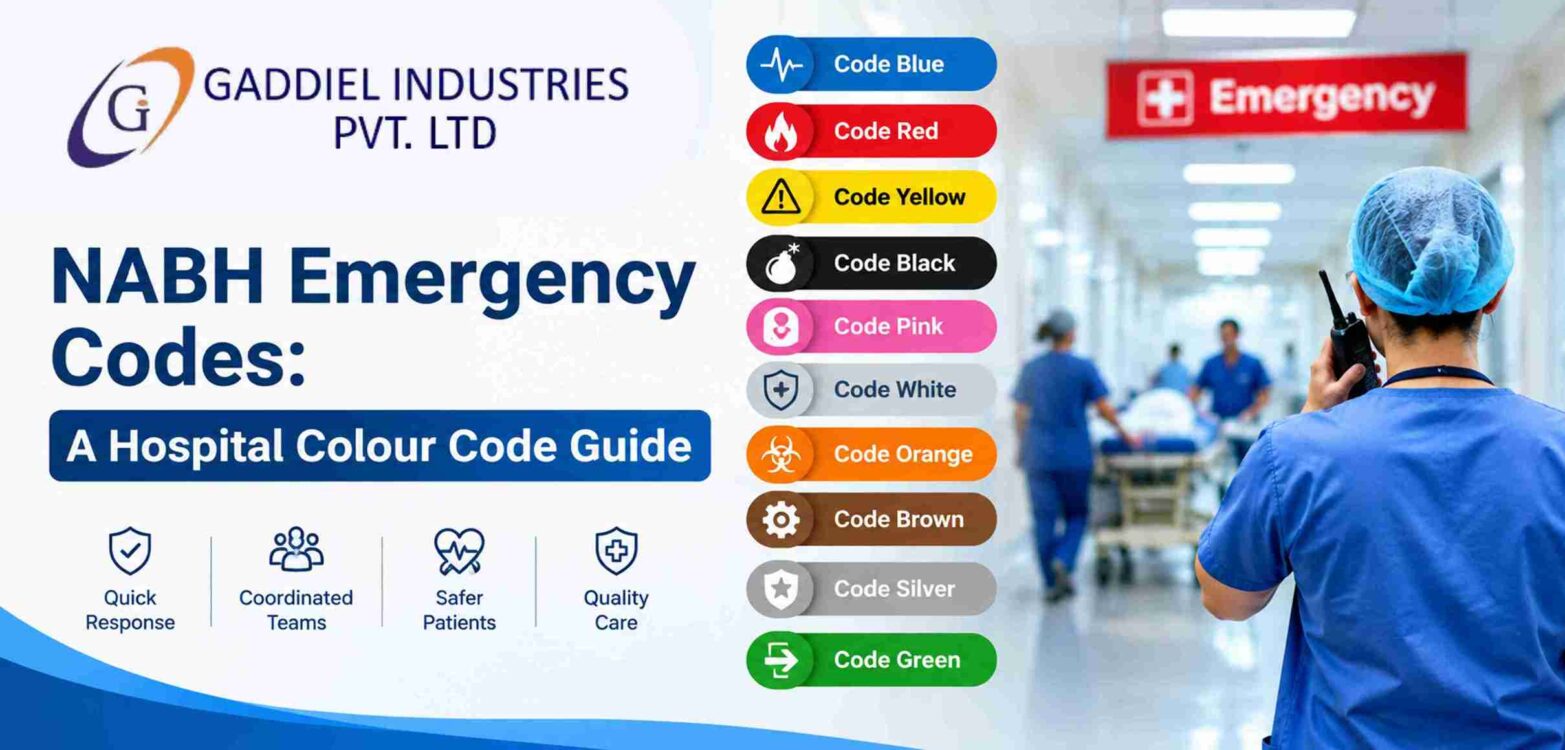
NABH does not prescribe a single emergency colour chart for every hospital — each facility is expected to formulate, approve, and implement its own version based on its specific needs. However, the NABH emergency codes and commonly used colours across Indian hospitals follow a relatively consistent pattern, creating a familiar, industry-wide approach to communicating emergencies quickly and effectively. Explore the NABH emergency codes below –
Code Blue
A Critical situation for example, Carestop or difficult breathing; Simulation comes to the bed side to support the patients immediately.
Code Red
Fire and evacuation notice that activates the hospital’s firefighting and emergency response procedures in the affected area. As part of the NABH emergency codes, it alerts trained staff to respond quickly, control the situation, protect patients and visitors, and evacuate nearby areas when necessary.
Code Yellow
An internal disaster or mass-casualty incident that may exceed the hospital’s normal capacity.
Code Black
A bomb threat or suspicious, unattended object found on the property.
Code Pink
Missing child: the immediate activation of an exit lockdown due to a missing infant or child.
Code White
A violent or aggressive (patient, visitor, etc.) who threatens physical safety to others.
Code Orange
An exposure to a chemical, biological or radioactive material in the building
Code Brown
An internal hospital failure, such as loss of a utility or loss of structure, or something outside the hospital that fails to limit access internally.
Code Silver
A weapon, a hostage situation—considered among the highest alerts the hospital can issue.
Code Green
Shifting of a ward, floor or entire hospital building.
Because they aren’t standardised nationally, staff transferring to another hospital are retrained on that unit’s chart instead of assuming the previous employer used the same colours.
Why NABH Takes This System So Seriously
A laminated colour chart stuck on a wall would mean nothing without NABH assessors. The key element in an accreditation review is if the hospital can demonstrate that it has an operating, tested system:
- Emergency code policy printed and posted publicly to every department, not just the upper administration.
- Mock drills that she schedules – most notably for high-frequency codes like Code Red and Code Blue.
- Code charts were posted only in staff areas, away from public-facing spaces where they might confuse patients.
- Review absents, both after drills and when real accidents occur – and update protocols when deficiencies arise.
- Code training included as part of new-hire orientation, repeated in quarterly refreshers and given a full session each year.
Read Related – Medical Equipment Suppliers & Exporters in India
What This Means for Patient Trust
The vast majority of patients will never be aware that a code has been called, and that’s as it should be — the best code systems work without being consciously experienced at all. But hospital administrators see it as something tangible, a facility that has pre-planned for crises instead of forcing one when it arrives. That differentiation makes its way into patient-safety scores and is a tangible factor in overall hospital quality ratings by accreditation organizations.
Final Thoughts
From Code Blue, which signals a cardiac emergency, to Code Silver, which may indicate an armed threat, the colour-coded system of NABH emergency codes followed by hospitals demonstrates the importance of an organised and coordinated response during critical situations. These codes help healthcare teams act quickly, calmly and according to predefined emergency protocols, reducing confusion and supporting patient safety. It is a relatively minor detail that patients are least likely to notice — and for exactly that reason, it may be one of the strongest indicators of how effectively a hospital prepares for and manages those critical moments.
Do you have questions about accreditation of hospitals or compliance with healthcare standards? Contact us at Gaddiel Industries Pvt Ltd — We will be happy to assist you!