

29
JulLet’s explore the laminar air flow: functions and uses in hospitals…..
One of the critical requirements in today’s healthcare facilities is to keep a clean and contamination-free environment. Hospitals carry out surgeries, intensive care treatments, and procedures where a single stray microorganism in the air could heighten the frequency of an infection.
This is exactly where laminar air flow systems in a Modular OT come into play. Awareness of laminar air flow function, how a plenum works, and what the role of laminar air flow is in hospitals can greatly help healthcare department decision-makers take assertive steps for the well-being of patients as well as staff— ensuring a safer ambience, better infection prevention, and superior control.
What is Laminar Air Flow?
Laminar Air Flow (LAF) is an airflow system that operates in a controlled manner to deliver filtered air at a constant speed and uniform direction. This means that the system uses HEPA (High-Efficiency Particulate Air) filters to suck out dust particles, bacteria and other airborne toxic particles from the air.
For a hospital environment, laminar air can be horizontal or vertical:
- Vertical Laminar Air Flow: Clean air is discharged from the ceiling and flows vertically downward towards the floor.
- Horizontal Laminar Air Flow: The clean air moves horizontally across the room.
Relative flow rates — vertical systems More often than not, vertical systems are more commonly used in operation theatres since their ability to push contaminants away from the surgical area.
Read Related – OT Full Form in Medical: Everything About Operation Theatre
Role of Laminar Air Flow in Hospitals
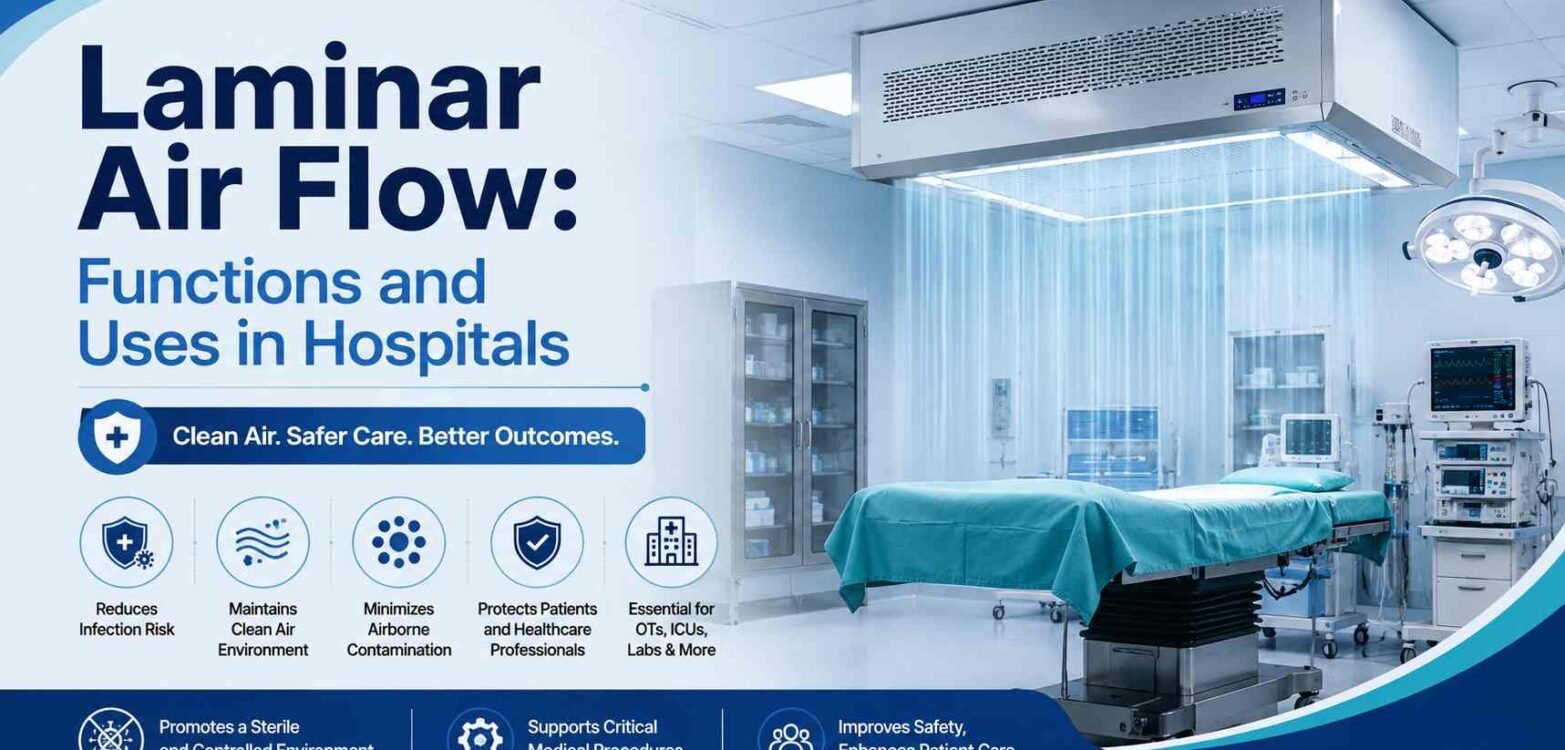
The function of laminar air flow is to maintain cleaning conditions and also control airborne particles and microorganisms. The system constantly provides filtered air and prevents dirty air from entering sensitive regions.
- Air Filtration
It works by pulling real-time air from the vicinity and running it through HEPA filters, which are capable of filtering 99.97% of PM2.5 sized particulates (down to.3 Mayrons). This greatly lowers the level of bacteria, viruses and dust.
- Uniform Air Distribution
With Laminar Airflow, air flows in parallel streams and is free of turbulence. In turbulent airflow, particles are carried in erratic motion making it difficult to predict the movement of contaminants. Uniform airflow maintains consistent cleanliness of the surgical field.
- Removal of Contaminants
When clean air enters the room, it displaces the airborne contaminants from critical zones. This contaminated air is then expelled through exhaust vents or return air ducts.
- Pressure Control
Most hospital LAFs keep operation theatres and clean rooms at positive air pressure. If you open the doors, unfiltered air cannot enter due to positive pressure.
- Temperature and Humidity Regulation
The advanced laminar airflow systems are integrated with HVAC systems to control the heating and relative humidity at a preferred level, thereby ensuring comfort for both patients as well as the equipment.
Use of Laminar Air Flow in Hospital
Various department laminar air flow hospitals are used for infection control management in hospitals.
Operation Theatres
Laminar airflow systems are most commonly used in operation theatres. The patient in surgery has their body exposed which is open to infections by the airborne route. LAF systems create a sterile zone immediately surrounding the surgical table and other instruments.
Intensive Care Units (ICUs)
Many of the patients in an ICU do not have fully functional immune systems. Helps to decrease transmission of airborne pathogens and makes the environment safer for critically ill patients by laminar airflow.
Organ Transplant Units
Patients who have received a transplant need to be in extremely sanitized places so that they do not get an infection after the surgery. LAF systems also ensure strict quality of air to be maintained inthe transplant operation theatres and recovery rooms.
Burn Units
Patients with large burns are particularly prone to sepsis as the skin barrier is compromised. What laminar air flow does is to minimize exposure – you breathe there and the organisms stay inside.
Pharmaceutical and Sterile Preparation Areas
LAF systems are also utilized by hospitals in pharmacy clean rooms, where sterile injections, IV fluids and other medications are prepared.
Read Related – Healthcare Industry in India: Current Market Size, Growth, and Future
Types Of Laminar Air Flow Systems And Its Benefits
Reduced Hospital-Acquired Infections
One of the greatest benefits is reduced hospital acquired infections (pull out HAIs). Lower rates of airborne pathogens reduce the number of surgical site infections and other airborne infections.
Improved Patient Safety
The sterile space leads to enhanced surgical outcomes with lesser complications, early recovery and shorter hospital stay.
Protection for Medical Staff
Such masks also protect doctors from breathing harmful airborne particulate matters and infectious agents.
Compliance with Healthcare Standards
Numerous healthcare accreditation organizations recommend or enforce the use of laminar airflow systems in the operating room as well as other critical settings to guarantee infection control standards.
Enhanced Equipment Performance
A dust-free environment is essential for the efficient operation of sensitive medical equipment, lowering maintenance needs and improving equipment life.
Various parts of a Laminar Air Flow Unit
Components of a Hospital LAF system include followings –
- HEPA Filters
- Pre-filters
- Air handling unit (AHU)
- Blower or fan system
- Diffusers
Every individual component has to work as it should if you are going to get proper air filtration and airflow control.
Maintenance Requirements
Laminar air flow systems need to be periodically maintained in good working order.
Filter Inspection and Replacement
The HEPA filters would be tested at intervals and replaced as per the manufacturers guidelines.
Airflow Velocity Testing
Maintenance personnel need to ensure airflow velocity stays within the ranges needed for laminar at all times.
Particle Count Monitoring
Special guidelines for hospital clean rooms include conducting airborne particle counts.
Cleaning and Sanitization
The diffusers, ducts and materials in local surfaces should be cleaned correctly and routinely to avoid microbial growth.
Read Related – Medical Equipment Suppliers & Exporters in India
Conclusion
Laminar air flow in hospitals is an essential functional unit, serving to filter and trendy the sterile air at a uniform state. Laminar air flow is especially relevant in operation theatres, ICUs, transplant units, burn wards and sterile preparation areas wherein the control of infection is paramount.
laminar airflow systems not only provide a clean environment by reducing airborne contamination but because they maintain positive pressure and deliver consistent air quality throughout the room, they greatly address concerns of patient safety in addition to improving clinical outcomes. For hospitals which want to fulfill the requirements of contemporary health care facilities and minimize infection danger, getting the best laminar air flow system is not just powerful but also obligatory.