

18
JunLet’s talk about medical disposable items or disposable surgical products here below..
Each hospital purchase manager, procurement officer & store in-charge feels the pain — an exhaustive list of needs, limited budgets to work with, plethora of vendors promising much but end up offering little more than specials for sale-free goods vs approved ones. This confusion with medical disposable items is more than a logistical nightmare. It is a risk — to patients, staff and the standing of your institution overall.
Gaddiel Industries Pvt. Limited has been dealing with hospitals, surgical centers, and institutional buyers for many years. Along with supplying essential healthcare solutions, including Modular OT equipment, one recurring question we hear more than any other is: What disposable medical products are approved, and where can I find a credible list? But what does this actually mean, and how should it be approached in a clear, practical way without all the jargon that often infects product guides? This blog is our attempt to answer just that.
Procurement is more than price and availability. And in the medical supplies space, sourcing from an unregulated or uncGnc is a compliance failure just waiting to happen — and it will be patients who pay first.
What “Approved” Actually Means Here
The word “approved” in the trade of medical supplies is a challenge. A vendor can declare a product approved because it has been in the market for years. That is not acceptance — that is comfort. A truly certified medical disposable items is one which conforms to requirements of the Central Drugs Standard Control Organisation (CDSCO) under Medical Devices Rules, 2017 for that device and has a valid licence issued by manufacturing facility carrying certification either directly from BIS or any other internationally recognized standards ISO 13485 or CE marking.
At Gaddiel Industries, we do not supply products that lack supporting documentation or paperwork to confirm their authenticity. All our products are provided with traceable regulatory paperwork — because that is an obligation a real supplier has to its customers.
Read Related – AI in Healthcare: Revolutionizing the Medical Field
The Core Categories of Disposable Medical Equipment
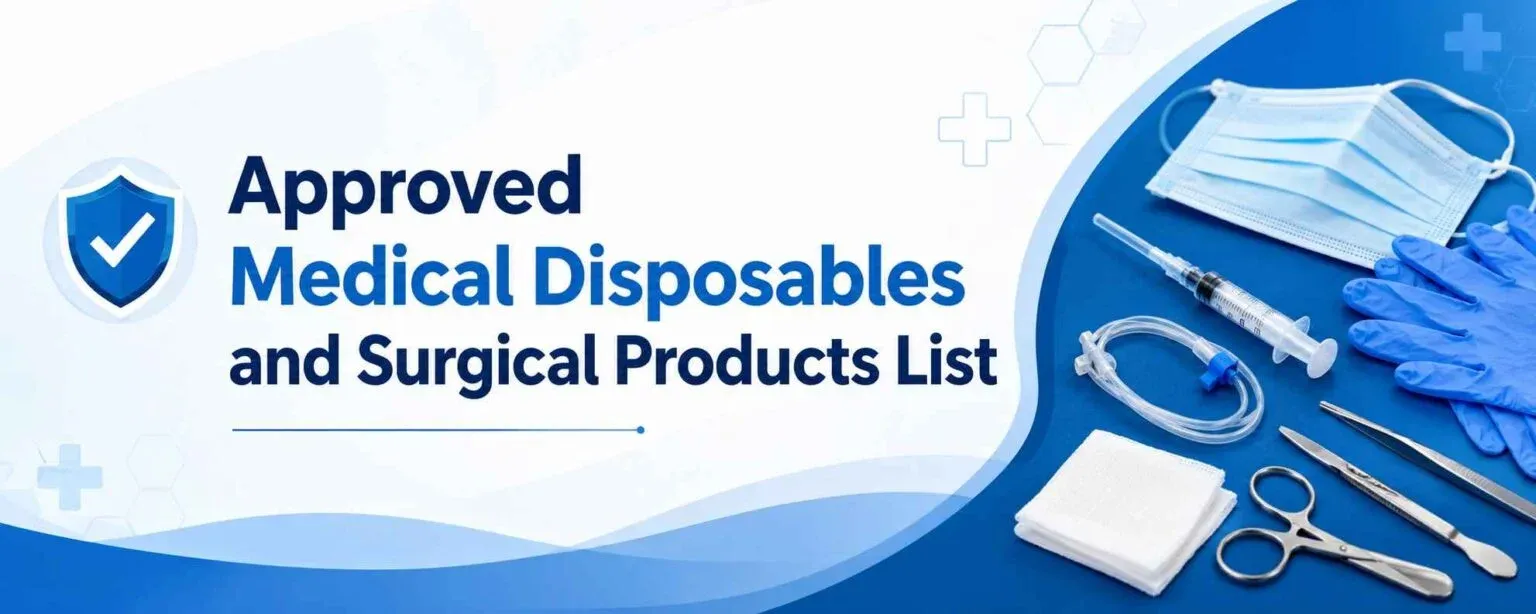
Here is the practical category-wise summary of medical disposable items which are often required in hospitals, nursing homes and surgical facilities across India.
Wound Management Consumables
The essential daily usage in any ward is composed of sterile gauze, wound dressings, adhesive strips and the like beside transparent film dressing and absorbent pads. There is high volume, frequent turnover and quality control at the sourcing level alone serves as a reliable check.
Injection and Infusion Supplies
IV cannulas, infusion sets, blood transfusion with hypodermic needles and various capacity syringes. You must package each unit in a sterile pack, with an expiry date and unique batch number for traceability. There is no compromise when it comes to sterility standards in this category.
OT for Disposable Surgical Products
Class B and Class C — for example, durable surgical disposable products used in the operation theatre (hospital consumables) — include sterile drapes, gowns, surgical gloves, instrument covers and trocar sheaths as single-use staplers. There is no compromise on CDSCO for this category of suppliers, and you should not continue to make such a supplier as your vendor who cannot prove their duly documented pedigree.
Respiratory and Critical Care Disposables
The most crucial medical disposable items or products related to patient risk, as portrayed by you are endotracheal tubes (ETT), suction catheters, oxygen masks and nebuliser kits and ICU breathing circuits. Obtaining from a licensed, traceable supply chain is not an option for ICU and emergency scenarios — it represents the customary of treatment.
Urological Consumables
Foley catheters as well as urine collection and drainage bags are high-volume items on most wards, along with nephrostomy kits. Whenever longer-term catheterisation is needed, silicone-coated versions according to ISO 10555 or a comparable standard should be used.
Diagnostic and Lab Sampling Supplies
For example, although the products used in an operating theatre (OT) or intensive care unit are typically given significant scrutiny through procurement reviews and similar processes, other items such as vacutainer tubes, lancets, blood collection needles, sterile swabs, specimen bags, fillings & containers. They should not. The test was run on a tube that had been contaminated : How is the diagnostic going to be accurate? The downstream impact of an incorrect result far outweighs the marginal saving on a poor consumable.
Same Old Procurement Mistakes
The pattern is so predictable after innumerable years in this area. First is that they buy strictly on price, especially when the difference between a certified and juicio-uncertified product seems minor or even non-existent. The second is presupposing that a product on the market unencumbered needs to be approved. It may not be. The weakest and most expensive of these is the outdated documents on what products are stored. A facility is not quiet in recovering from a regulatory inspection that finds non-registered medical disposable items on the shelves.
Read Related – Medical Equipment List: Names and Their Uses
How Gaddiel Industries Pvt. Ltd. Supports Your Procurement
We provide FDA approved medical disposable items for hospitals, surgical centres, diagnostic labs and institutional buyers all over India. Complete regulatory documentation (which include CDSCO registration certificates, manufacturer licences, ISO certifications and batch-level traceability records) back our entire line of products. The reason we keep such lists is not because anyone has told us to, but because if a supplier cannot respond to documentation within an agreed time frame of 14 days then they should not be in the medical disposable items supplies chain anyway.
In the event that your facility requires a custom product list — by category, department or volume — we are capable of putting this together for you. We also partner with the procurement teams looking for a second opinion on compliance standing of their existing vendor.