



11
NovThe cost of installing a medical gas pipeline system (MGPS) in a hospital depends mainly on the number of beds and outlets, the gases you need, the length of copper pipework, and the source equipment such as manifolds, a liquid oxygen tank, compressors and vacuum plants. There is no fixed per-bed price, because a 30-bed nursing home with oxygen and suction in a few rooms is a very different project from a 200-bed hospital with ICUs, OTs and a central oxygen plant. This guide explains what drives MGPS cost, how to plan the system, and how installation is carried out step by step.
If you are new to the term, our guide to the MGPS full form explains what the system includes. Here we focus on planning and installing one.
What does an MGPS installation include?
A complete medical gas pipeline system has four parts that are planned and priced together:
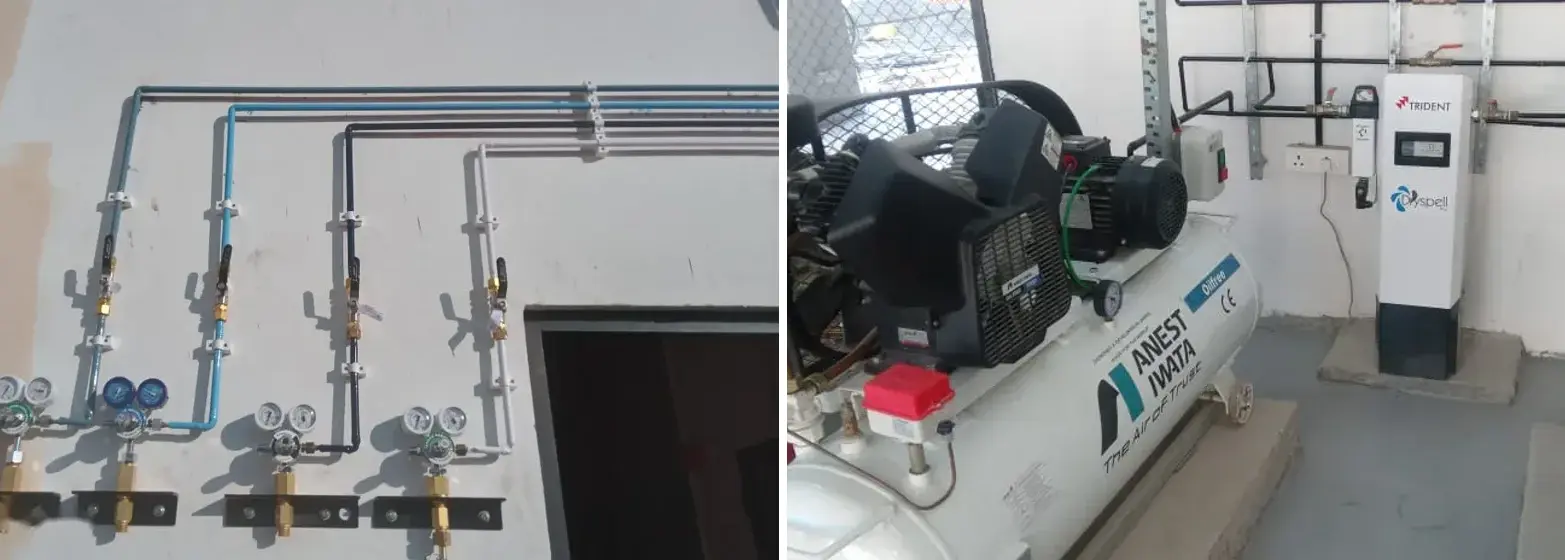
- Source equipment – oxygen and nitrous oxide manifolds, a liquid medical oxygen (LMO) tank or PSA oxygen plant, medical air compressors with dryers and filters, and vacuum pumps.
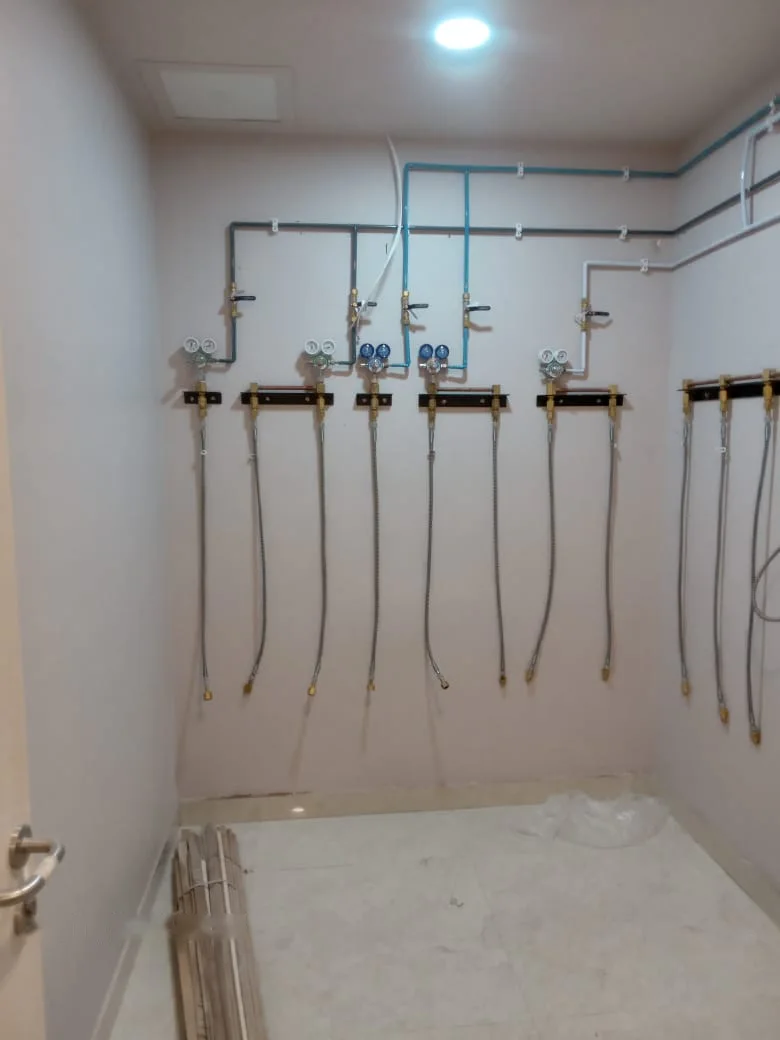
- Distribution pipework – medical-grade, degreased copper pipes running from the plant room to every floor, with isolation valves along the route.
- Zone control and alarms – zone valve boxes for each ward or department, area alarm panels and a master alarm that warns staff when pressure drops.
- Terminal units – the gas outlets at each bed, mounted on bed head panels, wall panels or OT pendants in operation theatres and ICUs.
Key factors that decide MGPS cost
| Cost factor | Why it matters |
|---|---|
| Number of beds and outlets | Each outlet needs a terminal unit, pipe drop and fittings. ICUs and OTs need far more outlets per bed than general wards. |
| Gases required | Oxygen and vacuum are the minimum. Adding medical air, nitrous oxide, carbon dioxide, surgical air (7 bar) or AGSS adds pipelines and plant. |
| Oxygen source | Cylinder manifolds cost less to set up. A liquid oxygen tank or PSA plant costs more upfront but lowers running cost for larger hospitals. |
| Pipe length and building layout | Number of floors, distance from the plant room and the route through shafts and ceilings decide how much copper and labour is needed. |
| Alarm and monitoring level | Basic pressure gauges cost less than digital area alarms and a central medical gas monitoring system. |
| New build or running hospital | Installing during construction is simpler. Retrofitting a running hospital needs night work, phased shutdowns and more protection. |
| Brand and standards | Outlets, valves and alarms built to recognised standards (such as ISO 7396-1 and HTM 02-01) cost more than unbranded parts, but they are safer and easier to get approved. |
How to plan an MGPS before you ask for a quote
Good planning keeps the system safe and avoids paying twice for changes. Before you request a quotation, prepare the following:
- List every area and its gas needs. Typical planning is oxygen and vacuum in wards; oxygen, medical air and vacuum in ICU, NICU and emergency beds; and oxygen, nitrous oxide, medical air, vacuum and AGSS in operation theatres.
- Fix the bed and outlet count per area. This is the single biggest input for both pipe sizing and cost.
- Decide the oxygen source. Smaller hospitals often start with cylinder manifolds; larger ones add an LMO tank or PSA plant with a manifold as back-up. LMO storage needs a PESO licence, so plan the location early.
- Choose the plant room location. It should be ventilated, accessible for cylinder or tanker delivery, and as close as practical to the main load.
- Plan pipe routes with the architect. Pipework should run through shafts and ceilings before false ceilings and wall finishes go up, with zone valve boxes near the entry to each department.
- Allow for future expansion. Sizing main lines for future beds costs little extra now and avoids replacing pipes later.
Gaddiel’s team can prepare this layout as part of hospital designing, so the MGPS, interiors and modular OT are planned together.
MGPS installation process, step by step
- Site survey and design – load calculation, pipe sizing and drawings for each floor.
- Plant room set-up – installing manifolds, compressors, dryers, vacuum pumps and the oxygen source.
- Pipework – laying medical-grade copper pipes and brazing joints with nitrogen purging so no oxide forms inside the pipe.
- Zone valves and alarms – fitting zone valve boxes, area alarm panels and the master alarm.
- Terminal units – mounting gas-specific outlets on bed head panels, wall panels and pendants, so the wrong equipment cannot be connected.
- Testing and commissioning – pressure and leak tests, cross-connection tests to prove each outlet gives the right gas, flow tests and gas purity checks before handover.
- Training and documentation – as-built drawings, test certificates and training for engineering and nursing staff on alarms and shut-off valves.
How long does MGPS installation take?
Timelines depend on hospital size and site readiness. In a new building, pipework is laid in stages as each floor is ready, and the plant room and testing are completed before the hospital opens. In a running hospital, work is usually phased ward by ward to keep patient areas in use. A clear layout and early decisions on gases and the oxygen source are what keep the schedule on track.
Common mistakes that raise MGPS cost later
- Choosing outlet counts too low and adding outlets after walls are finished.
- Undersizing main lines, which causes pressure drops when new beds are added.
- Skipping zone valves or alarms to save cost, which makes maintenance and emergencies harder.
- Using non-standard outlets that are hard to maintain or source spares for.
- Leaving MGPS planning until after interiors are designed.
If you are planning a new hospital or upgrading an existing one, share your floor plans with us for a site-specific MGPS layout and quotation. We install medical gas systems across India, including MGPS in Delhi and MGPS in Mumbai. You can also read about NABH standards for medical gas pipelines.
Planning a Modular OT, MGPS or Nurse Call project?
Talk to Gaddiel’s engineers for a free consultation and a clear, itemised quotation.
Get a Free Quote WhatsApp Us Call +91 99110 15263Frequently Asked Questions
How much does MGPS installation cost for a hospital?
There is no fixed rate. The cost depends on the number of beds and outlets, the gases required, the oxygen source (cylinder manifold, liquid oxygen tank or PSA plant), pipe length and the alarm system. Share your floor plan with an MGPS supplier for an accurate, itemised quotation.
Which gases are supplied through a hospital MGPS?
Oxygen and medical vacuum are the basic gases. Larger hospitals also pipe medical air, nitrous oxide, carbon dioxide, surgical air for power tools, and an anaesthetic gas scavenging system (AGSS) in operation theatres.
Which pipe is used in a medical gas pipeline system?
Medical-grade, degreased and capped copper pipe is used, with joints brazed under nitrogen purging so that no oxide forms inside the pipe.
Can MGPS be installed in a running hospital?
Yes. Installation is planned in phases, ward by ward, often with night work and temporary oxygen supply, so patient care continues during the work.
How is an MGPS tested before use?
Before handover, the system is pressure and leak tested, checked for cross-connections so each outlet delivers the right gas, flow tested and checked for gas purity. Test certificates and as-built drawings are given to the hospital.